Visual Management in Manufacturing: What It Is and How to Implement It
The art of management – whether of society or a company – resolves around making informed choices about the allocation of resources.- The road ahead
Visual Management in Manufacturing: A Practical Implementation Guide
Visual management is one of the foundational pillars of lean manufacturing — and one of the most underutilised tools on the shop floor. This guide explains what it is, why it works, and how to implement it in a way that actually sticks.
What Is Visual Management in Manufacturing?
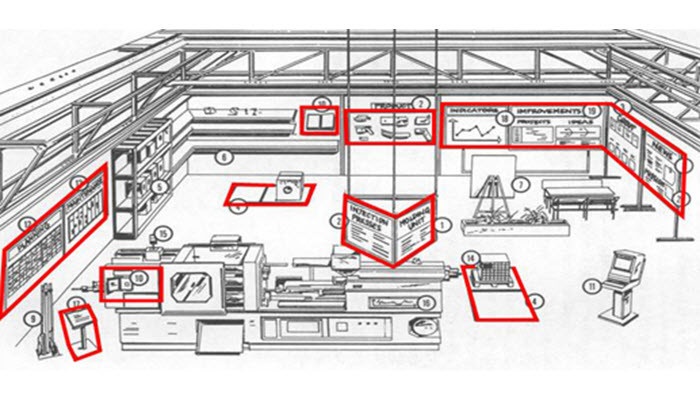
Visual management is a communication system in which information is conveyed through colour, symbols, and graphical cues rather than text or verbal instruction. The goal is simple: any person in a given area should be able to understand the status of an operation, the location of materials, or the required action — without needing to ask anyone.
In lean manufacturing, visual management sits at the foundation of the lean house model, supporting standardised work, 5S, and continuous improvement. It is not a one-off project; it is an ongoing system that evolves alongside your processes.
Why Does Visual Information Work?
There is sound cognitive science behind the principle. MIT neuroscientists demonstrated that the human brain can process an image in as little as 13 milliseconds — far faster than reading and interpreting a line of text, which typically takes 100–200 milliseconds per word. This neurological advantage is why visual cues reduce cognitive load and allow workers to respond to process information more quickly and reliably than written instructions alone.
| Citation Potter, M.C., Wyble, B., Hagmann, C.E., & McCourt, E.S. (2014). Detecting meaning in RSVP at 13 ms per picture. Attention, Perception, & Psychophysics, 76(2), 270–279. MIT News: news.mit.edu/2014/in-the-blink-of-an-eye-0116 |
This principle translates directly to the shop floor. A three-colour bin system or a shadow board communicates status instantly — no reading, no interpretation delay, no dependency on tribal knowledge locked in a single experienced operator.
Benefits of Visual Management
The business case for visual management is well-established across lean literature. The benefits I return to when presenting the concept to production teams are:
- Safety first — hazardous areas, restricted zones, and emergency equipment are immediately identifiable without signage that has to be read and decoded.
- Knowledge transfer — process information is embedded in the workplace, not held exclusively by experienced operators. If your 20-year veteran is absent, the line does not stop.
- Faster response — status information is available at a glance; no supervisor needs to be found to answer what to do next.
- Standardisation — visual cues enforce standard operating conditions without constant supervision.
- Continuous improvement enablement — abnormal conditions become immediately visible, which is a prerequisite for any CI activity.
| Found this useful? I publish practical lean and engineering guides regularly. Join the list and get them direct to your inbox. |
Everyday Examples of Visual Management
Before looking at the factory floor, it is worth recognising visual management that already surrounds us. This is often the most effective way to introduce the concept to a sceptical audience:
- Traffic lights and road markings
- Colour-coded fire extinguishers (BS EN 3 standard in the UK)
- Fire exit signage (ISO 7010 compliant)
- Floor markings in supermarkets and car parks
- Pictographic menus
Once you start looking for it, visual management is everywhere — and that recognition is a useful lever when making the internal case for investment.
Where to Start: Highest-Impact Implementation Areas
In my experience, the most meaningful quick wins come from two areas: the floor and your inventory. Start there. A practical sequencing approach:
- Floor markings — Define walkways, machine zones, and hazard areas with durable floor tape or paint. Colour conventions should follow your site standard or BS 5499/ISO 7010 where applicable.
- Kanban and bin systems — Colour-code your bins to distinguish vendor-managed inventory, bought-out parts, and in-house manufactured components. Three colours can manage an entire stores function — complexity is not required at the outset.
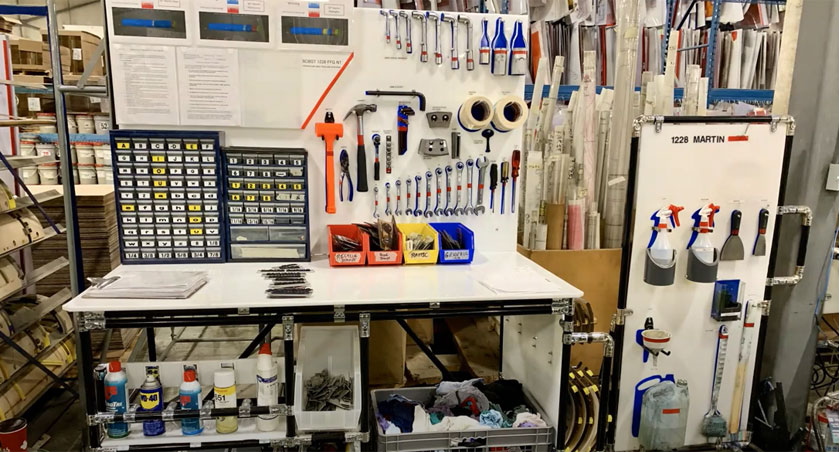
- Shadow boards — Tools, jigs, and fixtures with defined locations eliminate search time and make missing items immediately visible.
- SOPs at point of use — Laminated, diagrammatic SOPs mounted at eye level on the relevant workstation. Diagrams and photographs, not paragraphs of text.
- Performance feedback charts — Safety, quality, delivery, and throughput data displayed at cell or line level, updated on a defined cadence, with clear red/green status indicators.
Start with the easiest item on your list. A quick win builds internal credibility and makes the next implementation easier to resource and justify.
Where Visual Management Goes Wrong
Well-intentioned implementations become counter-productive when information density is not managed carefully. Signs, charts, and labels multiply over time — and when everything is flagged as important, nothing is.
When your visual management system starts to feel like noise, ask three questions:
- Is this information relevant to this area, process, or role? If not, it should not be here.
- Is this information current? Outdated charts and obsolete signage actively erode trust in the system.
- Has the process changed? Visual management must be maintained in the same review cycle as your SOPs, jigs, and fixtures.
The most effective systems I have encountered are also the simplest. A three-year-old can follow LEGO assembly instructions — that is the benchmark. Clarity and relevance always outperform comprehensiveness.
A Real-World Example: The Three-Bin Colour System
At one of my previous sites, we implemented a three-colour bin system to manage three distinct inventory streams: vendor-managed inventory, bought-out Kanban parts, and in-house manufactured components.
The system used three colours repeated consistently — on the bins themselves, on the shelf locations, and on the replenishment routes. No written instructions were required for day-to-day operation. New operators understood the system within their first shift.
That simplicity was deliberate. The objective of any visual management system at early implementation is adoption. A system that is slightly less sophisticated but universally understood and consistently followed will always outperform one that is technically comprehensive but routinely bypassed.
| Key Principle Start simple. Visual management grows with the lean maturity of your organisation and the skill level of your workforce — it does not need to arrive fully formed on day one. |
Visual Management and Continuous Improvement
Visual management is not a destination — it is a live system. As your lean maturity increases, as your workforce skills develop, and as your throughput demands change, your visual management must evolve with them.
At mature lean sites — such as those following the Toyota Production System model — visual management extends to production control boards, andon systems, and digital dashboards that provide real-time line status. The principle remains constant: make the current state immediately visible so that anyone can identify normal from abnormal at a glance.
Build a review cadence into your visual management from the outset. Treat it with the same discipline as an SOP or a calibration schedule.
Frequently Asked Questions
| FAQ | |
| What is visual management in lean manufacturing? | A communication system in which workplace information — process status, material flow, safety hazards, and performance data — is conveyed through colour, symbols, and graphical cues, enabling anyone in the area to understand the current state immediately. |
| Where should I start with implementation? | Start with floor markings and inventory systems. These deliver the highest visible impact with the least complexity. Quick wins build internal credibility and make subsequent implementations easier to resource. |
| How does visual management support continuous improvement? | By making abnormal conditions immediately visible, it creates the trigger condition for CI activity. If deviation from standard cannot be seen, it cannot be reliably acted upon. |
| What is the difference between visual management and 5S? | 5S (Sort, Set in Order, Shine, Standardise, Sustain) is a workplace organisation methodology. Visual management is the communication layer that makes the outputs of 5S self-explanatory. The two are complementary and typically implemented together. |
| Can visual management be applied outside manufacturing? | Yes — road markings, colour-coded fire extinguishers, and hospital ward status boards are all examples. The same principles apply in logistics, healthcare, construction, and office environments. |
Resources and Further Reading
- Greif, M. (1991). The Visual Factory: Building Participation Through Shared Information. Productivity Press.
- Hirano, H. (1995). 5 Pillars of the Visual Workplace. Productivity Press.
- Potter et al. (2014). Detecting meaning in RSVP at 13 ms per picture. Attention, Perception, & Psychophysics, 76(2), 270–279. MIT News summary: news.mit.edu/2014/in-the-blink-of-an-eye-0116
- Lean Enterprise Institute: lean.org — free resources on lean tools including visual management.
- BS EN ISO 7010:2020 — Safety Signs standard, applicable to workplace visual safety systems (BSI).
- BS 5499 — Graphical symbols and signs; Safety signs, including fire safety signs (BSI).
Internal – Lean
Check out more Lean Manufacturing topics:
- What is Flow Production? Complete Implementation Guide 2025
- Learn what flow production is and how to implement it in manufacturing. Includes step-by-step process, real-world examples, and proven tools to increase output.
- How to create a Value Stream map
- Companies strive to reduce costs, create space and continuously imp, one way to help make this happen is by creating a Value Stream Map.
- How to…use the Theory of Constraints (TOC): Streamlining Production
- Unlock efficiency with Theory of Constraints! Learn to identify bottlenecks, optimize processes, and boost productivity for success.
- Success Story: Transforming Workflows with Continuous Improvement
- Explore a real-life success story of implementing continuous improvement activities. How the involvement of operators led to significant changes.
- How to..Conduct 3S
- Master 3S methodology (Sort, Set, Shine) with this complete lean manufacturing guide. Learn implementation steps, workplace organization, and 3S vs 5S differences from 22 years experience.



What are your thoughts? Have I covered everything or is there more you know and would like to share?
I’m always learning and improving this site and my blogs, so please feel free to get in touch with me via LinkedIn or this site to discuss any topics I have covered.
If you’re having trouble finding ways to progress check out these sites filled with free learning tools:


Discover more from The Chartered Engineer
Subscribe to get the latest posts sent to your email.
