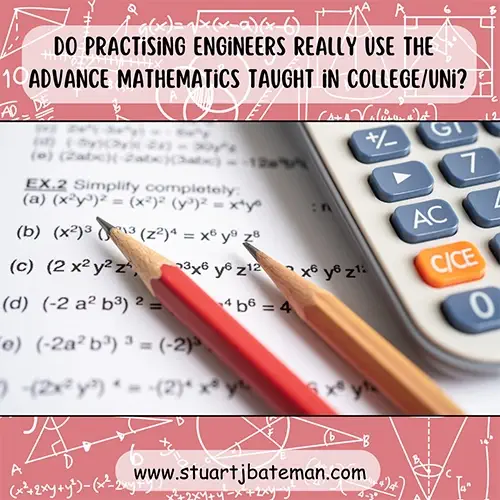
Do engineers really use the advanced mathematics taught in College/University?
You don’t rise to the level of your goals, you fall to the level of your systems. – Atomic Habits
So, do you reach for the pen and paper, or do you input the numbers into Google?
Do engineers really use advanced mathematics?
Today’s question “Do practising engineers really use the advanced mathematics taught in College/Uni?”
So, what is advanced mathematics? for me I would say: (Wiki definitions)
Calculus
- The study of Continuous change
Statistics
- The study of mathematics that involves the collection, description, analysis, and inference of conclusions from quantitative data.
Geometry
- The study of mathematics concerned with the properties and relations of points, lines, surfaces, solids, and higher dimensional analogues.
Algebra
- The study of mathematics that studies algebraic structures and the manipulation of statements within those structures.
Differential equations
- The study of mathematics, a differential equation is an equation that relates one or more unknown functions and their derivatives.
Logarithmic
- The study of mathematics, the logarithm is the inverse function to exponentiation.
Probably a few more
But while these are pure maths, most of engineering is formula based so depending on your engineering discipline you’ll have your own set to master.
Engineering advanced mathematics are mainly formulas we use.
For mechanical and manufacturing engineering, I deal daily with statistical and data science based maths, for the most part they are advanced mathematics to transform the data I collect into useful information that can be interpreted and used to improve/change systems.
When designing, design engineers have to consider environments/forces/material properties and manufacturing processes, each come with their set of formulas to calculate against, and having a sound understanding in the areas above allows an engineer to understand the information from their results.
Engineers use software for speed when we need to use advanced mathematics
While it’s rarer for an engineer to get a pen and paper these days to work out manually the maths, we have software that’s programmed to do most of this calculation after we input the variables, why? simply because it’s far more productive and speeds up the NPI process or DMAIC process, as resources are tight in most companies.
That’s not to say it’s not used, again engineer’s need to understand the advance mathematics to understand the answers from these software’s to be able to make informed decisions to progress with.
Software examples:
MATLAB – This is an industry standard software that covers analysis of data
PSPP – A statistical program developed by IBM
CAD/CAM – Used by design engineers, calculators are embedded into the simulation and modelling aspects of the programs, things like stress/strain/density etc.. Can be calculated
Python – Make you own calculators, add in the formulas
VBA (Excel) – Again, make your own calculator, but with excel you can design a friendly form to enter details into so others can benefit from it.
Should you be learning advanced mathematics?
So, yes this practising engineer uses advance mathematics I learnt both in College and University, and like many others I did say to my secondary school maths teacher “When are we ever going to use this?” and to my surprise I find that 20 years later I’ve been using them including many others to complete my daily tasks.
Don’t stop practising maths, as I’m often telling young engineers, my colleagues and others, it’s best to do a refresher on the basics of maths every 6 months or so. I like to practise daily using the sites below and ones like Brilliant.org that set me random questions to test my knowledge at the same time.
Even if you don’t go on to a engineering related job, you’ll find that the math skills you learnt on your course will come into use daily, below I share some resources that help me.
Websites & resources to help with engineering advanced mathematics formulas:
Rice University Basic Mechanics This Rice University educational resource covers fundamental mechanical engineering concepts for electronics and robotics courses. The page explains forces, torque, simple machines, gears, springs, and counterweighting with practical applications for building LEGO robots. It combines theoretical physics with hands-on mechanical design principles. https://www.clear.rice.edu/elec201/Book/basic_mech.html
PlanetCalc Professional Calculators PlanetCalc offers online mathematical and scientific computation tools for engineering and technical applications. This section provides calculators for geometry, trigonometry, physics, atmospheric calculations, and volume measurements. Tools range from basic arithmetic progression to complex spherical segment calculations. https://planetcalc.com/search/?section=838
Technology Student Technology Student provides educational information sheets and resources for pupils and teachers studying technology subjects. The site offers comprehensive learning materials covering various aspects of technology education and design. It serves as a reference for students in technology-related courses. https://technologystudent.com/index.htm
Engineering ToolBox The Engineering ToolBox is a comprehensive online reference with thousands of calculators, formulas, tables, and technical data for engineers. Topics span acoustics, fluid dynamics, HVAC, electrical systems, materials properties, thermal conductivity, and mechanical design. It covers virtually all aspects of engineering design from basic unit conversions to complex system calculations. https://www.engineeringtoolbox.com/
Unit Converters Unit Converters provides straightforward online conversion between various units of measurement across different systems. The site converts between the International System of Units (SI) and other measurement systems still in use worldwide. It offers simple conversions for length, weight, temperature, volume, and other physical quantities. https://www.unitconverters.net/
Engineers Edge Engineers Edge is an extensive engineering portal with over 150,000 webpages of reference data, calculators, standards, and training resources. The site provides engineering calculators, material data, design guidelines, GD&T training, and manufacturing information for mechanical engineers. It serves as a comprehensive destination for design professionals seeking technical information and problem-solving tools. https://www.engineersedge.com/
RapidTables RapidTables offers free online calculators, conversion tools, and reference tables across multiple disciplines including math, electrical engineering, and web design. Tools range from basic arithmetic calculators to specialized electrical calculations, unit converters, and coding references. It provides quick access to commonly needed calculations without requiring registration. https://www.rapidtables.com/
eFunda Engineering Fundamentals eFunda provides college-level formulas and technical information specifically for mechanical engineering professionals. The site covers solid mechanics, materials science, strain calculations, and design processes as reference material. It’s managed by PhDs and experienced engineers to help practicing engineers recall fundamental concepts and formulas. https://www.efunda.com/formulae/formula_index.cfm
All About Circuits All About Circuits is one of the world’s largest independent online communities for electrical engineers with over 700,000 members. Founded in 2004, it offers free educational resources including open-source textbooks, technical articles, video lectures, calculators, forums, and worksheets. The site serves both students learning circuit design and professionals discussing cutting-edge technologies. https://www.allaboutcircuits.com/
Videos for advanced mathematics :
Differential Equations and Dynamical Systems: Overview
ME564 Lecture 1: Overview of engineering mathematics
Crash Course Engineering Preview
Find more resources in my resources section linked below!
Internal (Resources) – Engineering Mindset
It’s great to develop the skills required for an engineering career, but you need to develop you mindset in order to tackle complex engineering problems, for that I recommend the following articles:
- How to overcome your assumptions
- How I sharpen the saw
- How to detect biases with these tools
- How to use first principle thinking like Elon
- How to use Critical thinking


What are your thoughts? Have I covered everything or is there more you know and would like to share?
I’m always learning and improving this site and my blogs, so please feel free to get in touch with me via LinkedIn or this site to discuss any topics I have covered.
If you’re having trouble finding ways to progress check out these sites filled with free learning tools:


Discover more from The Chartered Engineer
Subscribe to get the latest posts sent to your email.
