Why Manufacturing Mistakes Are Never Random — And How to Stop Them
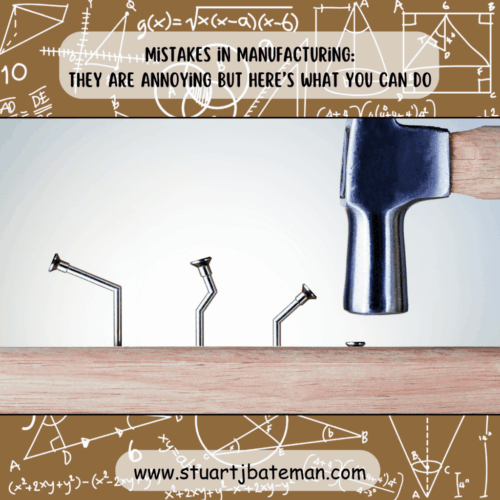
Understand the power of positive feedback loops- The road ahead
How to Prevent Mistakes in Manufacturing: Proven Methods
Manufacturing mistakes rarely come from careless operators — they come from broken processes. Whether it’s a missed screw, a contaminated part, or a wrong-revision drawing, the root cause almost always traces back to a gap in process design, not a gap in effort.
In this guide, I’ll walk through how to prevent mistakes in manufacturing using a three-stage framework: Identify, Analyse, and Control. I’ll draw on tools like PFMEA (Process Failure Mode and Effects Analysis), Poka-Yoke, SPC (Statistical Process Control), and the Five Whys — methods I’ve applied across real production environments.
These approaches work on the shopfloor, in the machine shop, in goods-in, packaging, and engineering. Wherever decisions are made and errors can creep in, this framework applies.
Why Manufacturing Mistakes Are Rarely Random
Operators are not the problem. The process is. When a step in a process makes it easy — or even likely — to make an error, that error will eventually happen regardless of how experienced or careful the person performing it is.
Mistakes most commonly originate from poorly designed NPI (New Product Introduction) implementations — new production lines, additional part variants added to existing lines, or process changes made to fix one problem that inadvertently create another. The process itself needs to be reviewed and improved, not the person following it.
Understanding that mistakes are symptoms of process failure — not personal failure — is the foundation of effective manufacturing defect prevention. It also creates the psychological safety needed for operators to raise problems openly, which is where root cause analysis in production always starts.
Step 1 — Identify and Detect Manufacturing Mistakes
You cannot fix what you cannot see. Before any analysis or corrective action can take place, you need reliable methods to surface mistakes consistently.
Go to the Shopfloor First
The single most effective identification method costs nothing: go and work on the line. Talk to operators, video the process, and do the job yourself if you can. What looks efficient on a process map often reveals friction, improvisation, and workarounds when observed directly.
Key actions: shadow operators during a full shift, record video of the process for later review, and ask specifically: “What makes this difficult?” rather than “Are there any problems?”
Non-Conforming Reports (NCRs) and Pareto Analysis
Implement an NCR (Non-Conforming Report) system to capture parts that fail to meet specification, along with the reason and location in the process where the issue was found. Train operators to raise these without blame — the report is against the process, not the person.
Once you have a dataset of NCRs, build a Pareto chart. This visualises defect types by frequency and makes it immediately clear which categories account for the majority of your non-conformance volume. The Pareto principle holds that roughly 80% of defects typically come from 20% of causes — so this is where you focus first.
Useful metric: also implement an Out-of-Box (OOB) measure with your distributors to capture packaging and transit-related issues that may not surface until the product reaches the customer.
PFMEA — Mapping Risk Before It Happens
A PFMEA (Process Failure Mode and Effects Analysis) is a structured risk assessment that maps every step of your process, identifies what could go wrong at each step (the failure mode), scores it for severity, likelihood, and detectability, and defines control measures.
PFMEAs are most valuable when created during NPI and reviewed with a cross-functional team that includes operators, supervisors, and process engineers. If none exist for your current lines, create them retrospectively — the process of building one often surfaces risks that have been tolerated but never formally assessed.
Tip: Existing controls in your PFMEA should map directly to detection methods on the shopfloor. If a control says “operator inspection” but there is no defined check frequency or go/no-go gauge, the control is theoretical, not real.
The Five Whys Method
The Five Whys (5Y) is the fastest root cause analysis tool to implement and often yields disproportionate insight. Starting from the problem statement, ask “Why did this happen?” and repeat for each answer until you reach the systemic cause — typically around five iterations.
Its real power is participative: run a 5Y with operators present and they will frequently identify the true cause themselves. This builds ownership of the eventual solution and dramatically improves implementation uptake. It works especially well when triggered by NCR data.
Ishikawa (Fishbone) Diagrams
Ishikawa diagrams are best used retrospectively, after a significant mistake has occurred. They map potential causes across categories (machine, method, material, man, environment, measurement) and are particularly useful for complex faults where multiple contributing factors need to be explored simultaneously.
Common Types of Manufacturing Mistake
For reference, the categories of mistake most frequently captured in manufacturing environments include:
- Dropped or damaged components during handling
- Incorrect measuring — wrong gauge, wrong reference surface, or calibration drift
- Part or material contamination
- Incorrect tool, jig, or gauge used for the operation
- Poor or outdated work instructions
- Wrong program or revision loaded on a CNC or automated system
- Wrong material variant loaded at line-start
- Drawing revision errors not caught during ECO review
- Process disruption caused by operator changeover (new starters especially)
- Safety procedures bypassed under production pressure
Step 2 — Analyse and Prioritise Mistakes
Identifying mistakes gives you data. Analysing that data tells you where to act. Without structured analysis, effort gets spread across many small problems rather than concentrated on the few that drive the most non-conformance.
Statistical Process Control (SPC) and Control Charts
SPC (Statistical Process Control) uses data collected from a process to determine whether variation is within acceptable limits (common cause) or signals an anomaly that needs investigation (special cause). For machine-driven processes especially, an SPC chart displaying an out-of-control point is an immediate prompt to ask: what changed at that moment?
Control charts plot process output over time with defined upper and lower control limits. Sustained drift, sudden shifts, or points outside limits all indicate the process has been affected by something — a tool change, material batch, operator shift handover, or environmental factor. SPC makes these events visible in near real-time rather than after the damage is done.
Pareto Charts for Prioritisation
Pareto analysis on your NCR data converts a long list of problems into a clear ranked priority. The top two or three defect categories almost always account for the majority of your non-conformance volume. Tackling them first delivers the most measurable reduction in defect rate for the least resource.
Rebuild your Pareto chart after each significant corrective action to confirm the improvement has landed and to identify the next priority category.
Step 3 — Control and Eliminate Mistakes
Once you know what the problem is and where it comes from, the goal shifts to making the mistake either impossible or immediately detectable. There is a hierarchy of solutions here — from the most robust to the least.
Poka-Yoke (Error-Proofing)
Poka-Yoke (Japanese for “mistake-proofing”) is the gold standard of defect prevention in manufacturing. Rather than relying on operator vigilance, a Poka-Yoke builds a physical, electronic, or procedural mechanism into the process itself that either prevents the error from occurring or immediately signals when it has.
Classic examples include jigs that only accept a correctly oriented part, torque drivers that lock out until a specified value is reached, and sensor arrays that confirm all fasteners are present before a station releases the component. A well-designed Poka-Yoke reduces operator cognitive load while eliminating the failure mode entirely — it is the most reliable form of process control in manufacturing.
Standard Work Instructions and Visual Management
Operators can only make the right decision if they have the right information at the right moment. Standard Work Instructions (SWIs) should be written at point-of-use, written with operators (not at them), and updated whenever a new failure mode is identified and resolved.
Visual management extends this: colour-coded bins, physical shadow boards, boundary samples, and go/no-go gauges at station all reduce the cognitive demand on the operator and make non-conformance immediately visible. A good visual management system means a new operator can perform the task correctly on their first attempt.
Continuous Improvement
Continuous improvement — systematically reviewing a process and removing unnecessary steps, tooling changes, and handling operations — reduces the number of opportunities for mistakes to occur. Fewer touches, fewer transitions, and fewer decisions means fewer chances for error. This is why lean manufacturing error reduction and defect prevention are so closely linked: waste elimination and mistake elimination are often the same activity.
Six Sigma for Persistent Defects
Where a process continues to produce defects despite standard corrective actions, Six Sigma provides a more rigorous analytical framework. Using DMAIC (Define, Measure, Analyse, Improve, Control), Six Sigma identifies statistically significant input variables that drive output variation — finding the critical Xs that control the Y you are trying to fix.
Six Sigma is resource-intensive and is best reserved for chronic, high-impact problems that simpler tools have not resolved.
Offline Process Design
Designing process changes offline — using mock-ups, simulation, or line trials outside production hours — allows you to identify failure modes before they reach the live environment. Involve operators in this design phase. They will identify practical problems in minutes that a desk-based review would miss entirely.
When to Consider Automation
Automation is not the first answer — it is the last resort. Before committing to an automated solution, the process should be stabilised, streamlined, and proven to be beyond reliable human operation at the required quality level. Automating an unstable process simply automates its defects at higher speed.
Where automation is the right call — typically for high-volume, low-complexity, repetitive operations — it eliminates the human variable entirely and enables the process to run consistently beyond what fatigue, shift changes, or distraction allow.
Monitoring: Keeping Mistakes from Coming Back
Every corrective action should be followed by a defined monitoring period — agreed by the team, tracked against a baseline, and formally reviewed. Without this step, improvements that looked successful in isolation quietly degrade as processes drift and operator knowledge turns over.
Key metrics to monitor after a corrective action:
- Defect rate — number of non-conformances per unit or per time period
- Yield — percentage of parts passing first-time inspection
- Cycle time (CT) — deviations may signal workarounds or process instability
- Throughput — volume output per shift or per hour
- KPIs agreed with the department and reviewed at regular cadence
If a metric deviates from the new baseline within the monitoring window, treat it as a signal and escalate immediately. Early deviation after a change almost always means the fix was incomplete or has introduced a new failure mode.
Conclusion
Manufacturing defect prevention is not about finding fault with individuals — it is about designing processes that make mistakes difficult to make and easy to catch when they do occur. The Identify → Analyse → Control framework gives you a repeatable structure to do that, regardless of the department or the complexity of the process.
The same methods apply to supplier quality too. As Toyota demonstrated with its supplier development model, supporting your supply chain to improve their processes — rather than simply penalising them for defects — builds the kind of collaborative relationship that drives long-term quality improvement upstream.
The tools are proven. The framework is simple. The hardest part is starting — and the best place to start is on the shopfloor, talking to the people closest to the problem.
Frequently Asked Questions
| What is the most common cause of mistakes in manufacturing? |
| The most common cause is a poorly designed or insufficiently controlled process, not individual operator error. When the process allows a mistake to be made, it will be made — regardless of operator skill level. NPI implementations and process changes are particularly high-risk moments for introducing new failure modes. |
| What is Poka-Yoke and how does it prevent manufacturing mistakes? |
| Poka-Yoke (Japanese for “mistake-proofing”) uses physical mechanisms, sensors, or procedural checkpoints to make it physically impossible — or immediately visible — when an error occurs. Examples include jigs that only accept correctly oriented parts and torque drivers that lock out until the correct value is achieved. It is the most robust form of error control in manufacturing. |
| What is a PFMEA and when should you use one? |
| A Process Failure Mode and Effects Analysis (PFMEA) is a structured risk assessment that maps every process step, identifies potential failure modes, scores their severity, likelihood, and detectability, and defines control measures. It should be created during NPI and reviewed whenever a significant process change is made or a new defect type is identified. |
| How do you prioritise which manufacturing mistakes to fix first? |
| Use a Pareto chart built from your NCR (Non-Conforming Report) data. The Pareto principle typically holds that 80% of defects originate from 20% of causes. Fixing the top two or three defect categories first delivers the greatest reduction in overall non-conformance volume for the resource invested. |
| What metrics should you track after implementing a corrective action? |
| Monitor defect rate, yield, cycle time, and throughput over an agreed review period (typically 4–8 weeks). If any metric deviates from the new baseline, investigate immediately — early deviation after a process change almost always indicates the fix is incomplete or has introduced a secondary failure mode. |
| Does non-conformance management apply outside the shopfloor? |
| Yes. The same Identify → Analyse → Control framework applies to any process in any department — engineering, finance, goods-in, packaging, and machine shop alike. Wherever decisions are made, mistakes can occur, and the tools described in this guide are equally effective outside production. |
Internal – Lean
Check out more Lean Manufacturing topics:
- What is Flow Production? Complete Implementation Guide 2025
- Learn what flow production is and how to implement it in manufacturing. Includes step-by-step process, real-world examples, and proven tools to increase output.
- How to create a Value Stream map
- Companies strive to reduce costs, create space and continuously imp, one way to help make this happen is by creating a Value Stream Map.
- How to…use the Theory of Constraints (TOC): Streamlining Production
- Unlock efficiency with Theory of Constraints! Learn to identify bottlenecks, optimize processes, and boost productivity for success.
- Success Story: Transforming Workflows with Continuous Improvement
- Explore a real-life success story of implementing continuous improvement activities. How the involvement of operators led to significant changes.
- How to..Conduct 3S
- Master 3S methodology (Sort, Set, Shine) with this complete lean manufacturing guide. Learn implementation steps, workplace organization, and 3S vs 5S differences from 22 years experience.



What are your thoughts? Have I covered everything or is there more you know and would like to share?
I’m always learning and improving this site and my blogs, so please feel free to get in touch with me via LinkedIn or this site to discuss any topics I have covered.
If you’re having trouble finding ways to progress check out these sites filled with free learning tools:


Discover more from The Chartered Engineer
Subscribe to get the latest posts sent to your email.
