How to Become a Mechanical Engineer in 2026: Complete Roadmap
Engineering is achieving function while avoiding failure.
– Henry Petroski
How to Become a Mechanical Engineer in 2026: Complete Roadmap
I’ll be honest with you — I never had a Mechanical engineer roadmap. For over 10 years after finishing university, I was directionless, learning on the job, drifting from one opportunity to the next without any real sense of where I was going. I tried an apprenticeship once, failed the entrance test, and gave up. So I stuck with the academic path — not because it was the right choice, just because it was the most familiar one. Eventually I found my footing and set my sights on becoming a Chartered Engineer, but that clarity came far later than it needed to.
If you’re reading this, you’re already ahead of where I was. You’re looking for a roadmap. And here’s the truth: no one can hand you that roadmap — you have to build it yourself. But I can give you a framework to do exactly that.
In this post, I’m going to use the GROW model as a coaching structure, and weave in two of Stephen Covey’s 7 Habits of Highly Effective People — specifically Habit 2: Begin with the End in Mind, and Habit 3: Put First Things First. Together, these give you a powerful lens for designing your engineering career with intention.
“Why Can’t I Just… Be a Mechanical Engineer?”
You absolutely can. Nothing is stopping you from getting a job in engineering and letting your career take whatever shape it takes. But here’s the cost of that approach: you hand control of your future to other people and random opportunities. Your career becomes something that happens to you, rather than something you build.
The engineers I’ve seen reach the most fulfilling careers — whether that’s running their own firms, leading major programmes, or hitting financial independence on their own terms — almost all had one thing in common: they had a destination in mind, even a rough one, and they made deliberate choices to move toward it.
So yes, you can wing it. Or you can steer.
The GROW Framework for Your Mechanical Engineer Career
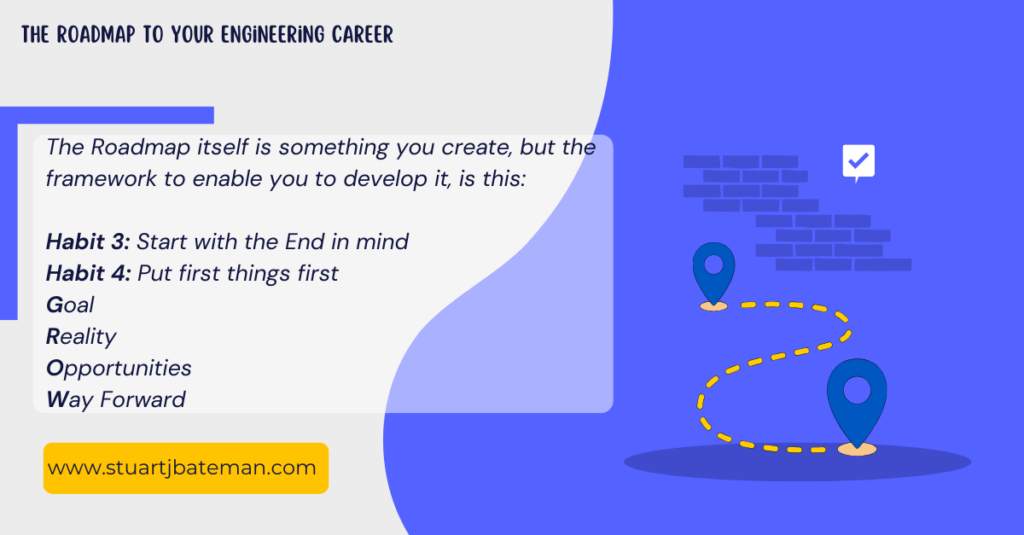
The GROW model is a coaching framework used worldwide to help people move from where they are to where they want to be. Here’s how it maps to your engineering journey:
- G — Goal: Where do you want to end up?
- R — Reality: Where are you right now, and what constraints shape your choices?
- O — Opportunities: What routes and fields are available to you?
- W — Way Forward: Which path is the right one for you, right now?
Let’s work through each one.
G — Goal: Begin with the End in Mind
Before you pick a university, an apprenticeship, or a company — before any of that — you need to think about the end. Not with rigid certainty, but with enough direction to make informed choices.
Ask yourself:
- When I retire, what kind of engineer do I want to have been? A hands-on technical expert? A Chartered Engineer? A business owner? A senior leader in a major aerospace firm?
- What does that life look like financially? What salary trajectory gets you there?
- Does this role exist in 40 years? Is there a sustained need for it, or is it at risk of automation or industry decline?
Some common engineering goals to consider:
- Becoming a Chartered Engineer (CEng) — the gold standard of professional recognition in the UK
- Building a career in senior technical or principal engineering roles
- Moving into engineering management or the C-suite
- Going independent as a contractor, consultant, or entrepreneur
- Retiring early with a specific financial target
You don’t need to commit to one for life. But having a stake in the ground gives you something to navigate toward.
R — Reality: Know Your Starting Point
Your current situation shapes which paths are actually open to you. This isn’t a reason to limit your ambition — it’s just context for making realistic, smart choices.
Consider:
- Are you still living at home? If so, you have far more flexibility — financially and geographically — than someone with a mortgage and dependants.
- Do you have a family or partner to consider? Relocating for the right opportunity might or might not be on the table.
- What’s your financial situation? Can you sustain a lower apprenticeship wage, or do you need to earn from day one?
- What’s your learning style? Do you thrive in structured academic environments, or do you learn better by doing?
- Where are you in your career? Are you a school leaver with a blank slate, or a career changer with transferable skills?
O — Opportunities: The Routes Into Mechanical Engineering
There’s no single path into mechanical engineering. Here are the main routes, each with honest trade-offs:
Academic — School → College → University → Job
The most well-trodden path, and the one most familiar to schools and parents. A degree in Mechanical Engineering (or a related discipline) opens doors with larger employers and provides a strong theoretical foundation.
- Pros: Highly recognised by employers; strong foundation in theory; well understood by larger employers; peer network built over several years.
- Cons: Significant time and financial investment (3–4 years plus tuition); can feel disconnected from real-world application; graduates sometimes struggle to bridge the gap between theory and practice.
Apprenticeship — Learn While Working
Degree-level apprenticeships have transformed this route in recent years. You earn while you learn, graduate debt-free, and build workplace experience from day one.
- Pros: Earn a salary throughout; no student debt; real-world experience from the start; increasingly respected by employers.
- Cons: Competitive to get into; the academic component can be demanding alongside full-time work; some employers still favour traditional graduates for senior roles.
Military / Armed Forces
The forces offer funded engineering training, professional development, and often a fast-track into structured technical roles. Many ex-forces engineers are highly sought after in industries like defence and aerospace.
- Pros: Fully funded training and development; strong discipline and leadership skills; excellent post-service employability.
- Cons: Significant personal commitment; not suited to everyone’s lifestyle or values; transitioning back to civilian engineering can require additional qualifications.
Volunteering and Side Projects
Some engineers develop their skills outside formal employment — through hobby projects, volunteering with engineering organisations, Formula Student teams, or community initiatives.
- Pros: Builds a portfolio; demonstrates passion and initiative; great supplement to other routes.
- Cons: Not a standalone route into engineering employment; takes self-discipline and personal investment of time.
Getting a Job and Working Your Way Up
This is the route I largely took. You start somewhere — even in a supporting role — and develop through experience, mentoring, and continuous learning.
- Pros: Earn immediately; learn in context; build industry contacts organically.
- Cons: Progress can be slow without intentionality; easy to drift without clear goals; harder to gain formal qualifications later without dedicated effort.
Design House or Specialist Firm
Working in a dedicated design or engineering consultancy gives you exposure to diverse projects across multiple industries. It can accelerate your technical development significantly.
- Pros: Fast-paced learning; variety of projects; good exposure to industry best practices.
- Cons: Can be high-pressure; may require existing experience to get through the door.
Freelance or Contracting
Once you have established skills and a reputation, contracting offers significant financial upside and flexibility.
- Pros: Higher earning potential; autonomy over the work you take on.
- Cons: Not suitable for beginners; income variability; self-management of taxes, IR35, and professional development.
Picking Your Field and Industry
Mechanical engineering is broad. The role of a design engineer in an aerospace firm looks nothing like a manufacturing engineer on a production line, or a structural engineer in civil infrastructure. Before you can pick a route, it helps to understand what direction you’re pointing.
Fields within Mechanical Engineering:
- Design Engineering
- Manufacturing Engineering
- Production Engineering
- Systems Engineering
- Stress / Structural Analysis
- Thermal / Fluid Dynamics
Industries to explore:
- Aerospace and Defence
- Marine and Offshore
- Rail and Transport
- Civil and Infrastructure
- Energy (renewable and conventional)
- Medical Devices
- Automotive
My advice — and this is something I wish I’d done far earlier — is to go and experience at least two or three different fields before you commit. Visit career fairs. Reach out to companies that offer open days or factory tours. Talk to engineers already in those roles. Ask them what their day actually looks like. Ask them what they wish they’d known.
Once you’ve experienced a few options, ask yourself:
Which of these could hold my attention for 30 or 40 years? Where do the job postings actually exist near where I want to live? What do those job descriptions require?
That last question is your most powerful research tool. Read job descriptions for the roles you aspire to. They tell you exactly what qualifications, experience, and skills employers want. That’s your map.
W — Way Forward: Choosing Your Path
Now you have all the pieces. You’ve got a goal, an honest picture of your current situation, and a clearer sense of which fields and routes appeal to you. It’s time to make a decision.
Ask yourself:
- Which route matches your learning style, financial situation, and timeline?
- What do the engineers already doing your target role typically have on their CVs? What was their path? LinkedIn is genuinely useful here — look up people in the roles you want and trace backwards.
- Which route keeps the most doors open toward your goal? Does your chosen path align with what your target employers and professional bodies expect?
- What’s the very first thing you need to do? Not the whole plan — just the next step.
That last point is where Covey’s Habit 3 comes in: Put First Things First. Once you know where you’re going, stop overthinking the whole journey and take the next concrete action. Apply for that apprenticeship. Enrol on that course. Attend that careers fair. Email that engineer and ask for a conversation.
A Quick Word From Experience
When I talk to young engineers starting out, I always encourage them to think about one question above all others: what will give me the most long-term benefit? Not the highest starting salary. Not the most prestigious logo on a CV. But the role, the company, or the experience that builds the skills and opens the doors that matter most ten or twenty years from now.
That might mean taking a slightly lower-paid role at a company with excellent mentorship. It might mean choosing a smaller firm where you’ll get broader exposure faster. It might mean prioritising a qualification now that pays dividends for the rest of your career. The short-term sacrifice is usually worth it — but only if you’re making the trade deliberately, eyes open.
Your 2026 Mechanical Engineer Roadmap: The Summary
The GROW framework isn’t a checklist — it’s a way of thinking. Use it now to get started, and come back to it every few years as your career evolves and your goals sharpen.
There’s no perfect route into engineering. There’s only the one that’s right for you, right now, with the goal you’ve chosen clearly in sight.
Now go build it.
Got questions about your specific situation or route? Drop them in the comments below — I read every one.
Resources (Internals) – Careers
Check out these interviews I conducted with 10 engineers you can find and chat to on LinkedIn:
- Danny Murphy – Automation Engineer
- Kyle Shropshire – Design Engineer
- Chris Stasiuk – Engineering Coach
- Bug Meehan – Design Engineer
- John McClure – Energy Engineer
And also check out these posts related to this topic:


What are your thoughts? Have I covered everything or is there more you know and would like to share?
I’m always learning and improving this site and my blogs, so please feel free to get in touch with me via LinkedIn or this site to discuss any topics I have covered.
If you’re having trouble finding ways to progress check out these sites filled with free learning tools:


Discover more from The Chartered Engineer
Subscribe to get the latest posts sent to your email.
