Personal Development for Engineers: Why You Need Mentors at Every Stage of Your Career
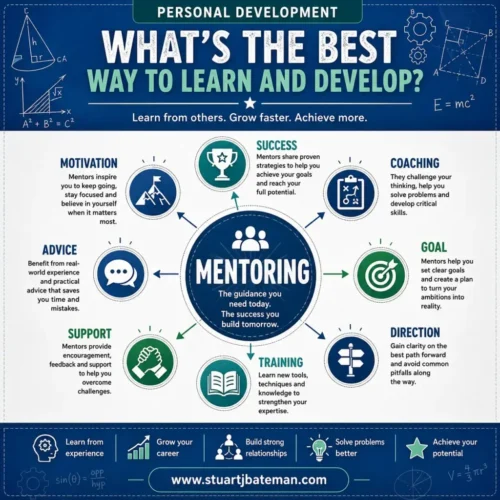
I think a role model is a mentor – someone you see on a daily basis, and you learn from them.
Denzel Washington
Most engineers understand the value of a good mentors when they are just starting out. What fewer realise is that the need does not go away. At every stage of an engineering career — graduate, mid-level, senior, chartered — there is knowledge you do not yet have, a perspective you have not considered, and someone ahead of you who has already navigated the terrain you are about to cross.
This post is about mentorship for engineers: why it matters at every career stage, what it actually gives you, where to find mentors when the obvious routes are not available, and what happens when you become one yourself. It draws on my own experience across three companies and twenty-two years — including the mentors I had, the ones I wish I had found sooner, and the books that filled the gap when people were not available.
Why Engineers Need Mentors — Not Just Graduates
The assumption that mentorship is a graduate-level tool is one of the most limiting beliefs in engineering careers. It is understandable — when you are new to a role, the knowledge gap is obvious and the need for guidance is immediate. But the gap does not close. It changes shape.
A mid-career engineer does not need someone to show them how to use a calliper. They need someone to help them navigate organisational politics, make the case for a budget, build influence without formal authority, or understand what Chartered Engineer registration actually requires and how to get there. A senior engineer needs challenge — someone who will test their assumptions rather than simply agree with them.
The engineers who grow fastest at every level are not always the most technically gifted. They are the ones who actively seek out people who know more than them, ask better questions, and absorb what comes back. That is mentorship. And it compounds.
What Mentorship Actually Gives You
Mentorship is about more than advice. Done well, it provides:
Finding a mentor gives you:
- Feedback — honest, direct, and from someone with no agenda other than your development
- Passing on knowledge, ideas, and — crucially — what not to do
- Leadership development through observation and guided experience
- Immersion in a different way of thinking and approaching problems
- The chance to explore new ideas together, in a space where being wrong is safe
Beyond the practical, a mentor helps you:
- Learn how they see things and how they tackle situations — not just what they decided, but how they thought about it
- Understand yourself — your strengths, your blind spots, and the gaps between where you are and where you want to be
And if you need a cultural reference point: even Jedi and Sith use mentors. The master-apprentice model is the oldest development structure in existence, and it exists because it works.
Mentors Come in More Forms Than You Think
The most common reason engineers give for not having a mentor is that they have not found one at work. That is a real constraint — but it is not the end of the conversation.
Mentors come in several forms:
Face-to-face at work — the most valuable form when it is available. A colleague, a manager, or a senior engineer who takes an interest in your development. If your organisation supports this formally, use it. If not, ask directly. Most experienced engineers will say yes if approached with a genuine question rather than a vague request.
Through your professional institution — I mentor younger engineers through a scheme supported by the IMechE. If you are a member of a professional body, check whether they run a formal mentoring programme. Many do, and the matching process means you are more likely to be paired with someone relevant to your area.
LinkedIn — for larger organisations especially, connecting with active colleagues or experienced engineers in your field opens a door to informal mentorship relationships that can develop over time.
Books — your mentor does not have to be alive. I have read widely across engineering, business, and biography — Steve Jobs, Bear Grylls, Richard Branson, Warren Buffett, Tim Ferriss, James Clear — and taken ideas and methods from each, tested them, and reformed them into experience I can base my own thinking on. A well-chosen book is a mentor who is available at any hour, never too busy, and never repeats themselves unless you ask.
The principle behind all of this is worth stating clearly. You are the sum of the environment and the people you surround yourself with. That applies in the workplace as much as anywhere else. Choose deliberately, and over time you will be shaped by those choices in ways that compound.
My Experience — Three Companies, Many Mentors
I was fortunate enough to have mentors at every stage of my career, though I did not always recognise them as such at the time.
At Lewmar, Steve Cook — my Engineering Manager — taught me how to programme CNC machines. That was not just a technical skill; it was the foundation of how I think about precision, process, and the relationship between design intent and what actually happens on the shop floor. Chris Tregust, also at Lewmar, built on that foundation. Both of them were generous with their knowledge in the way that the best shop floor engineers are — practical, direct, and patient with the right questions.
At Stannah, I had seven other manufacturing engineers around me, each carrying expertise from a different area: production, manufacturing, assembly, lean, design. That breadth of exposure in a single team was unusual and valuable. Each of them taught me something I still use. The collective effect was an education in how a manufacturing organisation actually works — not in theory, but in practice, through people who had made the mistakes and found the solutions.
At Accuracy International, three people shaped my development in different ways. An assembly manager taught me how to think about career growth — not just the next role, but the longer arc. A quality manager opened my eyes to continuous learning as a professional discipline rather than an occasional activity. And my line manager did something rarer and more valuable: he challenged my thinking. He pushed back on my ideas, questioned my assumptions, and forced me to defend my reasoning. That kind of mentorship is uncomfortable and essential in equal measure.
What I wish I had done earlier was seek this out more deliberately. For too long I assumed that development would come from the job itself, or from occasional training courses. It was not until I started my journey towards IEng — and read the requirements, understood what the qualification stood for, and found the motivation I needed — that I took real control of my own development. The lesson I pass on to every engineer I now mentor is simple: do not leave it to chance. Start with the end in mind, and work backwards from there.
Becoming a Mentor Yourself
At the mid-stage of a career, mentorship changes direction. You are no longer only the one learning — you are also the one who has something to teach, and becoming a mentor is one of the most effective ways to develop your own leadership and communication skills.
Taking on a mentee forces you to articulate things you have internalised. It is easy to do something well without being able to explain why. Mentoring surfaces those implicit assumptions and tests them. You will also find that the questions a mentee asks will reveal gaps in your own thinking that you had not noticed.
A structured approach helps. Discuss goals, develop an action plan, and assess skills gaps together — a SWOT analysis (Strengths, Weaknesses, Opportunities, Threats) is a useful framework here, whether used formally with a mentee or privately as a self-assessment tool.
Ask for feedback as often as you give it. Mentorship is a two-way relationship. The best mentoring conversations I have had have been the ones where I came away having learned something too.
When There Is No Mentor Available — Build Your Own Environment
Not every engineer has access to a formal mentor, particularly early in a career. The alternative is to build an environment that does the same work.
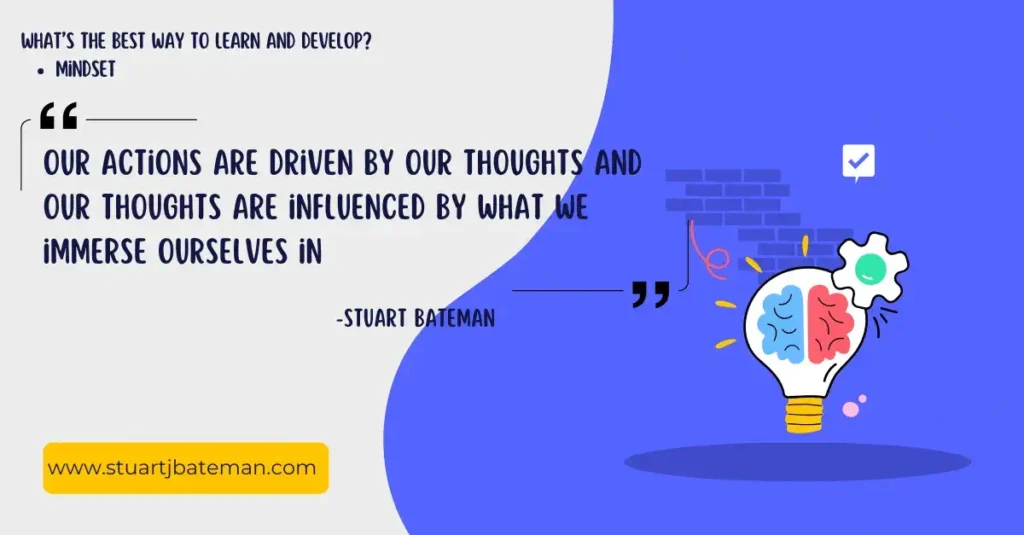
Tim Ferriss in The 4-Hour Workweek and James Clear in Atomic Habits both touch on a principle that goes beyond the well-known “average of five people” phrase: our actions are driven by our thoughts, and our thoughts are shaped by what we immerse ourselves in. If the environment around you is not pushing you forward, you have to construct one that does.
That might mean choosing books deliberately. Walter Isaacson’s biography of Benjamin Franklin traces an extraordinary self-directed development journey — Franklin’s early years as a printer’s apprentice gave him the practical foundation for everything that followed, including drafting the Constitution. The apprenticeship model is not a historical curiosity. It is the original version of what we now call mentorship, and it worked for the same reasons it still works today.
George Leonard’s Mastery describes what long-term development actually feels like: periods of growth, followed by plateaus, followed by growth again. That pattern repeats throughout a career, at every level. A mentor who has been through more cycles than you helps you recognise where you are in the pattern and resist the temptation to quit during the plateau.
Mentorship Is About…
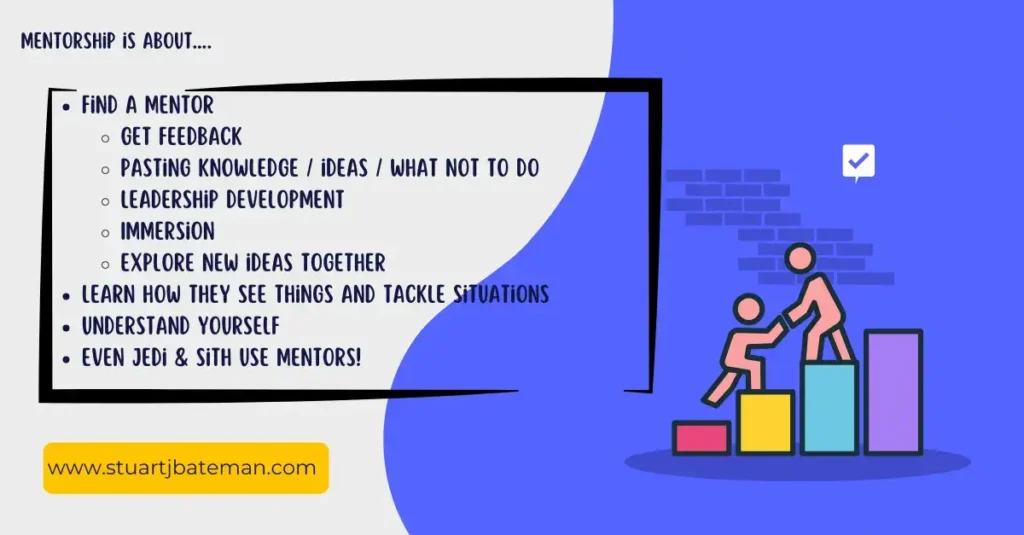
- Finding a mentor — and getting regular, honest feedback
- Passing on knowledge, ideas, and hard-won lessons about what not to do
- Leadership development through immersion in how others think and act
- Learning to see situations through a different lens
- Understanding yourself more clearly — your strengths, your gaps, your direction
- Exploring new ideas in a space where being wrong carries no penalty
- Even Jedi and Sith understand this. The master-apprentice model is the oldest development structure in existence. It has survived because nothing has replaced it.
Whatever stage you are at — start looking for your next mentor. And if you have been in your field for a decade or more, start looking for someone to mentor. Both directions compound.
Key Takeaways
- Mentorship is not only for graduates — the need changes shape but never goes away at any stage of an engineering career
- Mentors come in many forms: colleagues, managers, professional institution schemes, LinkedIn connections, and books
- The IMechE and other professional bodies run formal mentoring programmes — if you are a member, use them
- You are shaped by the environment and people you surround yourself with — choose both deliberately
- Becoming a mentor yourself develops leadership, communication, and the ability to articulate what you know
- Do not leave your development to chance — start with the end in mind and work backwards
- Mastery comes through cycles of growth and plateau — a mentor who has been through more cycles helps you stay the course
Frequently Asked Questions
Do engineers need mentors at every career stage?
Yes. The knowledge gap does not close — it changes shape. A graduate needs technical grounding. A mid-career engineer needs strategic guidance and challenge. A senior engineer needs someone who will test their assumptions. The form mentorship takes evolves, but the need for it does not disappear with experience.
Where can engineers find mentors?
The most common routes are: a senior colleague or manager at work, a formal scheme run by a professional institution such as the IMechE, LinkedIn connections within your organisation or discipline, and through the indirect mentorship of books written by people who have done what you are trying to do.
What does a mentor actually do for an engineer?
At its most practical, a mentor provides feedback, shares knowledge and experience — including what not to do — and helps identify skills gaps. At a deeper level, a good mentor challenges your thinking, helps you understand your own strengths and blind spots, and provides a model for how to approach situations you have not yet encountered.
What is the difference between a mentor and a manager?
A manager is responsible for your output. A mentor is invested in your development. The two can overlap — some of the best mentors I have had were managers — but they are not the same role. A manager’s feedback is shaped by the needs of the organisation. A mentor’s feedback is shaped by the needs of the person.
When should you become a mentor yourself?
There is no fixed point, but mid-career is a natural time to start. If you have ten or more years of experience in your field, you have knowledge and perspective that would be genuinely valuable to someone earlier in their journey. The process of mentoring is also one of the best ways to develop your own leadership and communication skills.
References & Further Reading
- Franklin, B. — referenced in Isaacson, W. (2003). Benjamin Franklin: An American Life. Simon & Schuster.
- Ferriss, T. (2007). The 4-Hour Workweek. Crown Publishers.
- Clear, J. (2018). Atomic Habits. Penguin Random House.
- Leonard, G. (1992). Mastery: The Keys to Success and Long-Term Fulfilment. Plume.
- Institution of Mechanical Engineers (IMechE) — Mentoring: imeche.org
Resource – (Internal) – Personal Development
Below are links to my 5 part series on Personal development:
- Making mistakes / assumptions and being wrong
- Can you detect Baloney
- First principles thinking
- Do you think it’s better to win?
- The Socratic method – Critical thinking



What are your thoughts? Have I covered everything or is there more you know and would like to share?
I’m always learning and improving this site and my blogs, so please feel free to get in touch with me via LinkedIn or this site to discuss any topics I have covered.
If you’re having trouble finding ways to progress check out these sites filled with free learning tools:


Discover more from The Chartered Engineer
Subscribe to get the latest posts sent to your email.
