Internal Networking for Engineers: Why Walking the Corridors Still Works
Everyone you will ever meet knows something you don’t
Bill Nye
Internal networking for engineers is one of the most overlooked career skills in the profession. Most career advice pushes engineers towards LinkedIn profiles, industry conferences, and external events — yet the relationships you build inside your own organisation can be just as career-defining, and far easier to start today. This post explains what internal networking actually means in practice, why it matters across every stage of your engineering career, and exactly what you can do about it right now.
What Does “Walking the Corridors” Mean?
“Walking the corridors” is a phrase used to describe the deliberate practice of moving around your workplace to speak with colleagues face to face, across departments and disciplines, not just when a task demands it but as a regular professional habit.
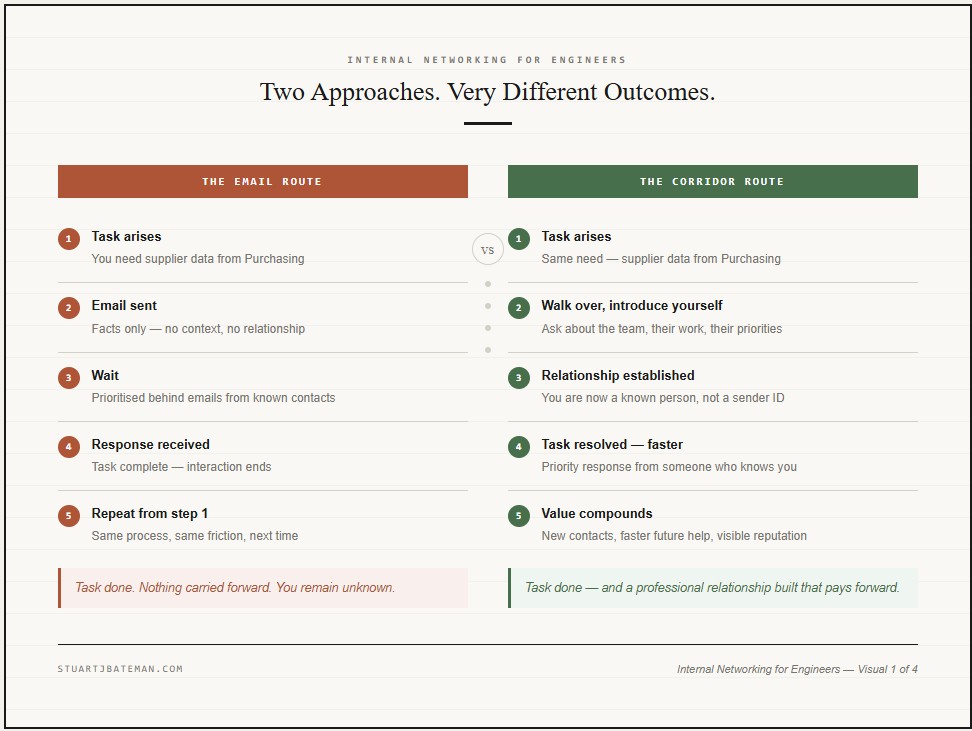
Think of it this way. You need to contact Anne in Purchasing to identify suppliers capable of quoting on a component you have designed — you need cost data and confirmation that the tolerances are achievable. You could send an email: factual, efficient, and entirely forgettable. Or you could walk over, introduce yourself, ask what her team does and what matters to them, and leave as someone Anne will recognise the next time your name appears in her inbox. One approach gets the task done. The other builds a contact who responds to you on a priority basis because she knows who you are.
That is the principle. Simple in concept, and genuinely powerful when applied consistently.
Who Is This For?
This post is written primarily for early-career engineers and engineering students, but the principle applies to engineers at any stage. Whether you are a graduate in your first role, a mid-career engineer looking to expand your influence, or an experienced practitioner who has always focused on the technical work — internal networking is a skill worth developing deliberately.
Why Internal Networking Matters for Engineers
To progress in an engineering career, technical ability will take you a long way — but it rarely takes you all the way on its own. The ability to build relationships, communicate across functions, and make yourself visible within an organisation becomes increasingly important as you move beyond purely technical roles.
That said, career progression is not the only reason this matters. Internal networking opens doors to more interesting projects, gives you access to knowledge and experience that no training course will provide, and creates the kind of professional safety net that is invaluable when problems arise — as they inevitably do in engineering.
The Benefits of Building Internal Networks
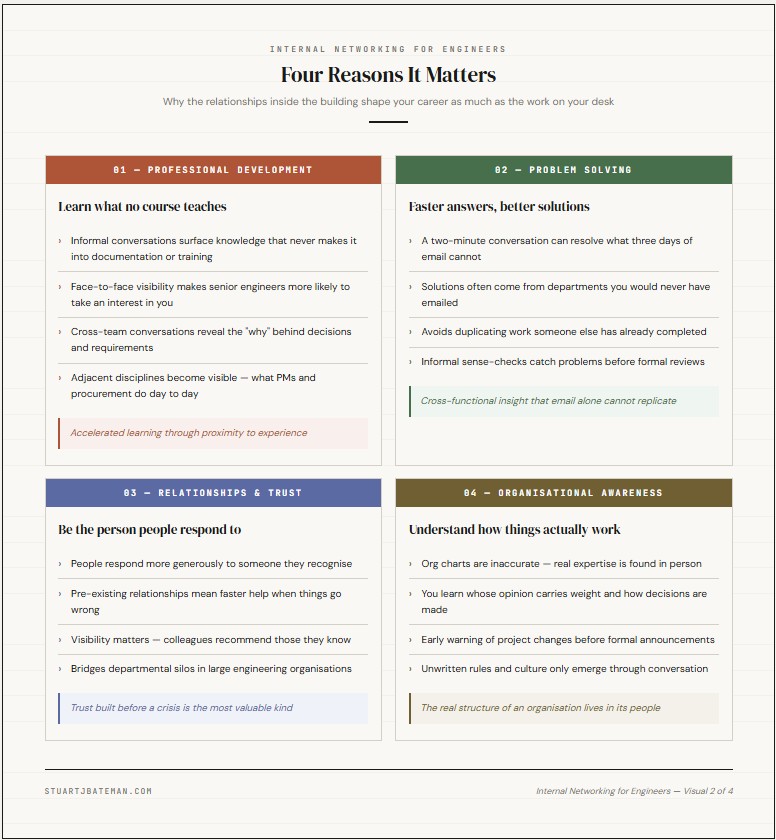
Professional Development
Informal conversations regularly surface knowledge that never makes it into documentation, training materials, or onboarding programmes. Speaking with senior engineers, project managers, and specialists across the business accelerates your understanding of how decisions are made, why requirements exist, and what constraints other disciplines are working within. It also puts you in front of people who may take an interest in your development in a way that a name on a spreadsheet never would.
Problem Solving
A two-minute conversation in a corridor can resolve something that would take three days over email. More importantly, the solution often comes from a department you would never have thought to contact. Internal connections reveal tools, templates, and solved problems that already exist elsewhere in the business — saving you from duplicating effort and from presenting half-baked ideas in formal reviews that a quick informal sense-check would have caught.
Relationships and Trust
People respond more generously to someone they recognise. When something goes wrong — and in manufacturing and production engineering, something always goes wrong — having pre-existing relationships means colleagues are more willing to help, move quickly, and give you the benefit of the doubt. Visibility matters: people recommend and support those they know when opportunities arise.
Organisational Awareness
Org charts are rarely accurate. The person who actually understands the capability of a machine, the history of a supplier relationship, or the reason a process was designed a particular way is found in person, not on a diagram. Walking the corridors gives you access to the real structure of an organisation: who holds knowledge, whose opinion carries weight, and how decisions are actually made — none of which appears in any official document.
Career Progression
Stretch assignments, secondments, and interesting projects are frequently offered to people who are already known and trusted before a vacancy is formally communicated. An internal reputation built over time through consistent visibility is a more durable career asset than any CV. Senior advocates who champion your progression typically emerge from repeated, genuine in-person interactions — not from a single impressive presentation.
What the Research and Professional Bodies Say
In preparing this piece, a range of engineering career resources were reviewed — from professional bodies including the IET and ASME, to career guidance platforms and university resources. A consistent pattern emerged: almost all existing networking advice for engineers is directed outward. Conferences, LinkedIn, industry events, and elevator pitches dominate the conversation. Internal networking — the relationships you build with colleagues across the corridor or on the floor above — is rarely given serious attention.
The academic evidence, however, supports its value clearly.
Stanford sociologist Mark Granovetter’s landmark 1973 study demonstrated that so-called “weak ties” — casual connections and loose acquaintances across different social clusters — were more useful in securing employment than close connections, because they serve as bridges between otherwise isolated groups. Applied to an engineering organisation, this means that the colleague in a department you rarely visit may be more valuable to your career than someone you already work with every day.
Professional bodies reinforce this in practice. The IET notes that engaging with colleagues from different departments or teams can uncover opportunities for collaboration and career growth, with informal settings such as lunch or coffee breaks providing a productive environment for internal networking. The Chemical Engineer highlights that it is not simply about who you know, but who knows you — and that time invested early in building a network pays dividends later when solving problems and accessing opportunities. NES Fircroft advises that engineers often overlook the fact that their own colleagues hold considerable knowledge and connections, and that asking questions and learning from those around you is one of the most efficient forms of professional development available.
A point worth noting, and one that applies directly to engineers: introversion is not a barrier. As both The Chemical Engineer and the University of Maine Pulp and Paper Foundation note, many experienced professionals actively want to share knowledge with younger engineers and will welcome the approach.
Sources: Granovetter, M.S. (1973). The Strength of Weak Ties. American Journal of Sociology, 78(6), 1360–1380. | IET Engineering Jobs | The Chemical Engineer | NES Fircroft | University of Maine Pulp and Paper Foundation
My Experience Across Three Companies
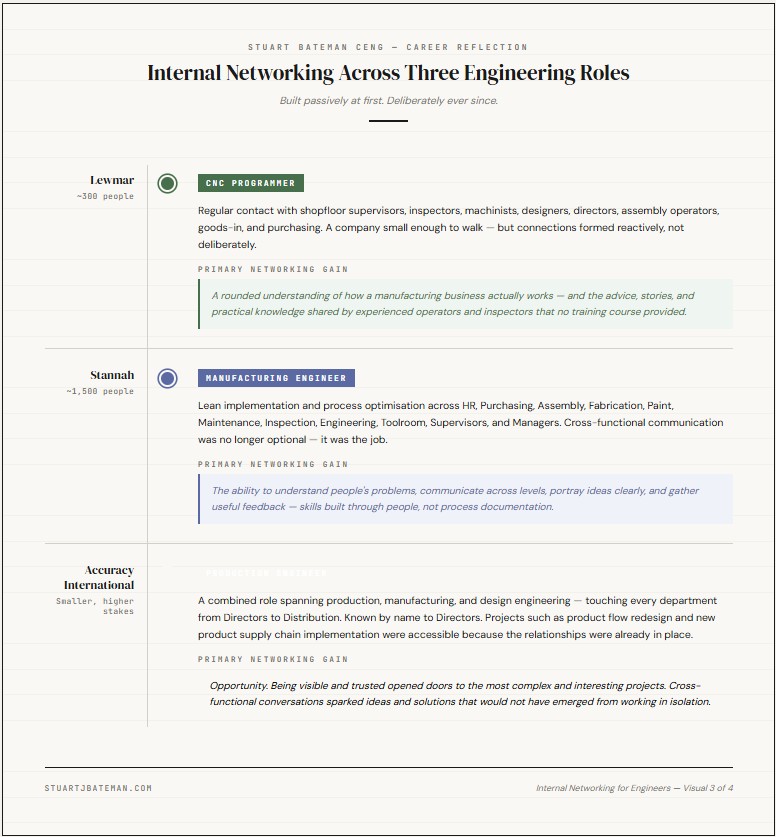
I was building internal networks long before I understood what I was doing — and reflecting on it now, I can see exactly what it gave me at each stage.
Lewmar was a company of around 300 people. As a CNC programmer, my regular interactions were with shopfloor supervisors, inspectors, and machinists — but I was also talking with designers, directors, assembly operators, goods-in staff, and purchasing. The company was small enough that walking around was natural. What I gained from it, particularly early in my career, was a rounded understanding of how a manufacturing business actually works. The advice, stories, and practical knowledge passed on by operators, assemblers, and inspectors who were willing to speak to someone prepared to listen and ask questions — that was the biggest benefit. No training course provided what those conversations did.
Stannah was a different environment — around 1,500 people — and in a Manufacturing Engineer role focused on lean implementation and process optimisation. Here, understanding people’s problems with faults, defects, and process issues was the daily work. The conversations were essential to gathering the information needed to design data collection systems, measure the problems, and then develop and sell solutions to the right stakeholders — often engineering, since improvements typically meant changes to assemblies or parts. What this built was something beyond technical skill: the ability to communicate across levels, read what someone actually needed, present ideas clearly, and take feedback on board.
Accuracy International was a step up in responsibility and a step down in headcount. The role covered production engineering, elements of manufacturing engineering, and some design engineering work — which meant projects touched almost every department. Having a Director know your name and understand your contribution to the business is a direct product of internal visibility. The projects I was offered — redesigning product flows, implementing supply chain changes — came through those connections. And when I was stuck on a problem, I could walk over to the engineering team or the inspection floor and pitch it informally. That kind of cross-functional problem-solving, sparked by an off-the-cuff conversation, happened regularly at AI and produced results that would not have come from working in isolation.
Common Mistakes Engineers Make with Internal Networking
These are patterns I have observed in others, and some I recognise in myself at earlier stages of my career.
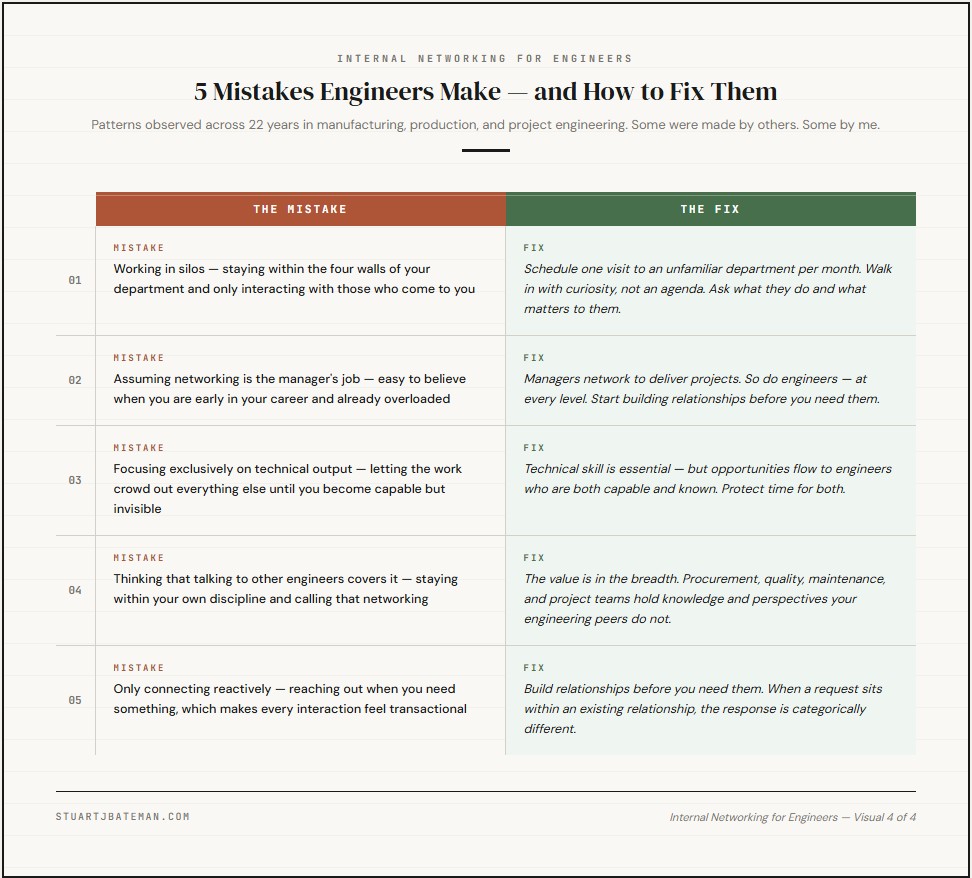
Working in silos. This is an old concept, but it persists — particularly in large organisations where the sheer size of the business makes connecting to other departments feel like additional work, or where the pace and intensity of technical tasks leaves little headspace for anything else. The result is an engineer who is technically capable but invisible beyond their immediate team.
Assuming it is the manager’s job. This was my own early mistake. When you are new and there is a great deal to absorb, it is easy to conclude that relationship-building and cross-functional communication belong to the management layer. Managers do need to network to deliver projects — but so do engineers, at every level, for exactly the same reasons.
Focusing exclusively on the technical work. Engineering roles reward technical output, and that focus is appropriate — but it can become a default that crowds out everything else. Engineers who invest only in their technical skills and treat people-facing activity as a distraction tend to find, over time, that opportunities flow to colleagues who are equally capable but considerably more visible.
Thinking that talking to other engineers covers it. Speaking with engineers in your own team or discipline is valuable, but it is not internal networking in the sense described here. The benefit comes from building connections across functions — procurement, quality, production, project management, maintenance — where different knowledge, different perspectives, and different access to problems and solutions exist.
Only connecting when the job demands it. Reactive networking — reaching out when you need something — is less effective than building relationships before you need them. When you approach someone only when you have a request, the dynamic is transactional. When you have already taken the time to understand what they do and what matters to them, the request sits within a relationship, and the response is different.
What You Can Do Today
These steps are straightforward to implement and require no special circumstances or permission.
- Block 30 minutes in your calendar and walk the floor. Visit a department you rarely enter. Introduce yourself, ask what the team does, and focus your questions on them rather than on yourself. People respond well to genuine interest in their work.
- Start a coffee exchange. Reach out to one person from a different department each month — not to discuss a task, but simply to learn about their role, their background, and what they find interesting or challenging about their work. This is low-pressure and builds genuine connections over time.
- Use your org chart deliberately. Identify the stakeholders or subject matter experts whose work intersects with yours — even loosely — and make a list. Send a short, courteous introductory email explaining who you are and why you are getting in contact. Do not follow up repeatedly if there is no response; the goal is to open a door, not to push through it.
- Ask your team who you should know. Colleagues who have been with the organisation for any length of time will have an accurate picture of who holds knowledge and influence in areas relevant to your work. That list is more useful than any org chart.
- Connect on LinkedIn within your organisation. For larger companies especially, identifying active colleagues on LinkedIn and making a connection there provides a low-friction starting point for a relationship that can develop in person.
Key Takeaways
Internal networking for engineers is not a soft skill add-on — it is a core professional capability that directly affects the quality of your work, the speed at which you solve problems, and the trajectory of your career. The evidence from professional bodies and academic research is consistent: relationships built before you need them are the ones that matter when you do. The practice is simple: get out of your immediate environment, speak to people, and be genuinely interested in what they do. It costs nothing except the willingness to start.
Frequently Asked Questions
- What is internal networking for engineers? Internal networking for engineers is the deliberate practice of building professional relationships with colleagues across different departments and disciplines within your own organisation — not just those you work with directly on daily tasks.
- Is internal networking as important as external networking for engineers? Both are valuable, but internal networking is frequently overlooked. The IET specifically notes that engaging with colleagues from different departments can uncover collaboration opportunities and support career growth that external networking alone cannot provide.
- How do I start internal networking if I am introverted? Introversion is not a barrier. Starting with a single, low-pressure conversation — asking a colleague in another department about their role — is sufficient. Professional bodies including The Chemical Engineer note that many experienced engineers actively want to share knowledge with those earlier in their careers.
- How often should I be building internal connections? There is no fixed frequency, but consistency matters more than volume. One genuine new connection per month, maintained through occasional follow-up, compounds significantly over a five-year career.
- Does internal networking apply in large engineering organisations? It applies in any organisation, but in large companies it requires more deliberate effort. The scale of the business means silos form more easily — which also means the competitive advantage of being well-connected internally is greater.
Author Bio
Stuart Bateman is a Chartered Engineer with 22 years of experience across project, manufacturing, and production engineering. He writes about engineering tools, career development, and practical manufacturing techniques for engineers at every stage of their career.
Resource – (Internal) – Personal Development
Below are links to my 5 part series on Personal development:
- Making mistakes / assumptions and being wrong
- Can you detect Baloney
- First principles thinking
- Do you think it’s better to win?
- The Socratic method – Critical thinking



What are your thoughts? Have I covered everything or is there more you know and would like to share?
I’m always learning and improving this site and my blogs, so please feel free to get in touch with me via LinkedIn or this site to discuss any topics I have covered.
If you’re having trouble finding ways to progress check out these sites filled with free learning tools:


Discover more from The Chartered Engineer
Subscribe to get the latest posts sent to your email.
