Mastering Complexity: A Practical Framework – Complete guide for 2026
The scientific mind does not so much provide the right answers as ask the right questions – Claude Levi-Strauss
Reducing Complexity: A Key to Efficiency
Complexity often stems from the number of interactions required to complete a task or understand a concept. The more intricate something is, the more time it takes to process, build, resolve, or evaluate. In manufacturing — as well as in various other industries and aspects of life — the benefits of reducing complexity have become increasingly evident. By simplifying, standardising, or eliminating complexities, we can mitigate errors, misunderstandings, confusion, and misguided actions, thereby fostering a more productive environment.
“Complexity characterises the behaviour of a system or model whose components interact in multiple ways and follow local rules, leading to non-linearity, randomness, collective dynamics, hierarchy, and emergence.”— Wikipedia
Identifying complexity is essentially a matter of quantifying these interactions and determining the threshold beyond which it becomes too cumbersome for either an individual or a group to manage consistently.
A Simple Process for Reducing Complexity
Here’s a practical five-step process to achieve this:
- Choose a task: Preferably one that consumes the most time, using Time studies.
- Break the task down: Break it down into its constituent steps (Work Breakdown Structure).
- Question each step: Determine their necessity. Can any steps be omitted while still accomplishing the task? Can they be redesigned for simplification? Is there a tool—software or hardware—that could streamline several steps?
- Streamline and Simplify: Remove unnecessary steps and implement changes as identified in step 3. Retest to ensure the task is now easier and can be consistently performed. If not, revisit step 2.
- Document the Process: Write down the revised procedure, ideally in a Standard Operating Procedure (SOP), for others to learn from. Revisit the process within a short timeframe to address any unforeseen issues that may arise.
Applying Lean Tools and Design Principles
While Lean tools such as Value Stream Mapping (VSM), Single-Minute Exchange of Die (SMED), and 5S can aid in process improvement, for design the focus should be on eliminating features and standardising components. Simplicity not only reduces the likelihood of breakdowns or failures — it also facilitates ease of use.
Managing Product Complexity in Manufacturing and Marketing
In manufacturing, complexity often lies in the number of processes required to produce a part. It also arises in marketing, where companies offer various product combinations and variations. Utilising tools like matrix-style tables to categorise product families against variations can help manage this complexity effectively across both functions.
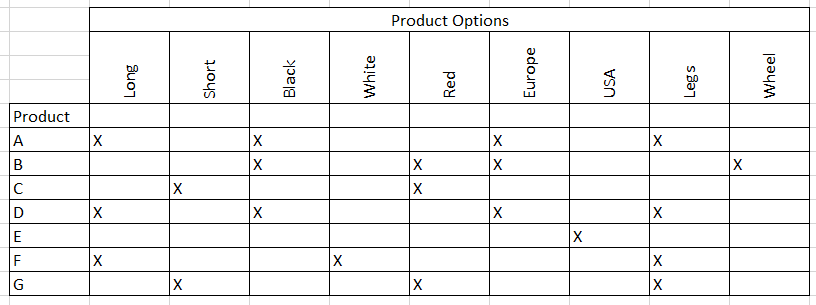
Look for patterns in what can be produced together. Eliminate low-demand or highly unique options that strain the supply chain disproportionately to their value.
While it’s understandable that a company needs to make money, the more complex its products become, the greater the demand placed on the supply chain to respond to a mixed-model schedule. Depending on the size of the company, the resources to manage this may simply not exist — making the hard decision to review and reduce product variations one of the highest-impact moves available. Freeing up capacity increases throughput on high-demand products.
Once stability is achieved and the company can grow, re-introducing variations gradually is entirely worthwhile to remain competitive in the market.
Ultimately, the goal is not complexity for its own sake, nor simplicity at the cost of capability — it’s about finding the right level of complexity that people can consistently manage. People naturally gravitate toward the path of least resistance; the organisations that recognise this design their processes, products, and systems accordingly. Simplicity isn’t a compromise — it’s a competitive advantage. By asking the right questions, as Lévi-Strauss suggested, and systematically removing what doesn’t need to be there, both people and businesses are freed to focus their energy where it matters most: delivering value.
External Lean – Resources
Want to learn more about Lean, then check out these 5 Lean organisation websites that I highly recommend:
Lean Smarts – LeanSmarts.com offers an online training academy designed to support lean manufacturing transformations through engaging video-based courses and certification programs Leanuk. The platform provides ready-to-use training materials with facilitator guides, covering topics like 5S, waste elimination, one-piece flow, pull systems, and visual management based on the Toyota Production System Leanuk. Organizations can deliver training through personal certification, facilitator-led sessions, their own training platform with up to 250 users, or integrate content into existing Learning Management Systems Leanuk.
Lean Academy – LeanUK.org (Lean Enterprise Academy) is a not-for-profit organization that helps individuals and organizations become self-reliant in lean thinking and practice through research, teaching, and coaching Leanuk. They conduct action research to develop learning materials and processes, deliver capability development through their online Lean Learning Platform and workshops, and share findings through events like the UK Lean Summit Leanuk. Founded by lean pioneer Dan Jones, they’ve been involved in developing and spreading lean thinking in the UK for over 40 years across industries including automotive, healthcare, government, and services Leanuk.
CI Tool kit – CIToolkit.com provides professionals, teams, and students with practical tools, methods, and resources for implementing continuous improvement and achieving operational excellence citoolkit. The site features libraries of downloadable infographics, team exercises and games for Lean and Six Sigma workshops, visual illustrations of concepts, and step-by-step how-to guides. It also offers digital products including training materials, templates, and worksheets designed to support continuous improvement journeys citoolkit.
iSixSigma – iSixSigma is a comprehensive online resource dedicated to Lean Six Sigma methodologies and continuous improvement practices isixsigma. The platform offers articles, case studies, and certification guides covering topics like Six Sigma, Lean manufacturing, Kaizen, and Business Process Management. It serves practitioners from beginners to experts seeking to reduce defects, improve efficiency, and drive business results through data-driven process improvement isixsigma.
Lean Production – LeanProduction.com is a free educational resource focused on lean manufacturing techniques and eliminating waste from production processes leanproduction. The site provides easy-to-understand guides on topics like 5S, TPM, OEE, and SMED, helping manufacturers improve efficiency, reduce costs, and increase productivity leanproduction. Brought to you by Vorne, it offers practical tools, templates, and resources designed to be quickly implemented by manufacturing teams looking to achieve measurable improvements in their operations.



What are your thoughts? Have I covered everything or is there more you know and would like to share?
I’m always learning and improving this site and my blogs, so please feel free to get in touch with me via LinkedIn or this site to discuss any topics I have covered.
If you’re having trouble finding ways to progress check out these sites filled with free learning tools:


Discover more from The Chartered Engineer
Subscribe to get the latest posts sent to your email.
